
Doodh
Darpan
दूध दर्पण
A controlled A/B field study revealing how hydroponically grown Nutri Ankurit Feed transforms dairy productivity, milk quality, and farmer income — even during peak summer heat stress in rural Uttar Pradesh.
Why summer is the hardest season for dairy farmers
India's smallholder dairy farmers depend on dry fodder and commercial concentrates — nutritionally inadequate, especially during peak summer. Temperatures exceeding 38°C impair rumen function, drop milk yields, and erode farmer incomes. Shunya Agritech developed Nutri Ankurit Feed (NAF), a hydroponically grown, chemical-free, moisture-rich feed delivered to farmers' doorsteps. Doodh Darpan was designed to measure its real-world impact.
A rigorous controlled trial
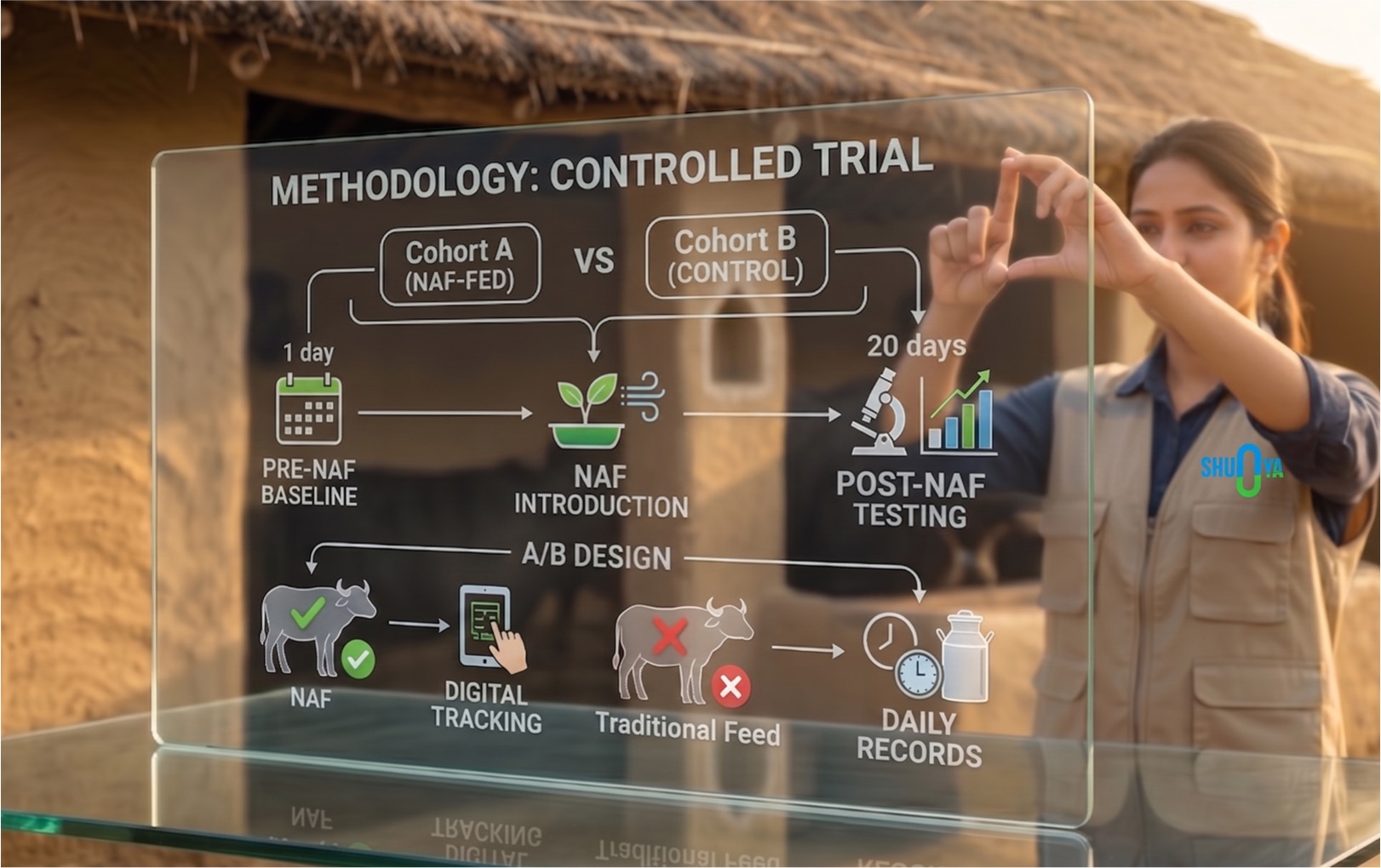
A Pre-Post Comparative A/B design across 6 villages, with two cohorts tracked over 23 days via digitally validated milk collection records.
Pre-NAF Baseline (May 2–9)
Both cohorts observed on their existing diets. Milk samples collected twice daily — morning and evening — using digitally calibrated analyzers.
NAF Introduction (May 9–25)
Cohort A (n=10 buffalos) received Nutri Ankurit Feed in a separate trough. Cohort B (n=6) continued traditional feed unchanged throughout.
Digital Traceability
Every fat/SNF assay and milk volume entry was logged electronically via partnered milk collection centres. Milk parchis (receipts) validated each data point.
Income Tracking
Each parchi reported per-litre price (linked to fat and SNF) and total milk revenue, enabling direct calculation of net earnings after feed costs.
Results at a glance
Average metrics per milking session, compared across pre- and post-NAF periods for both groups.
| Metric | 🌿 Test Group (NAF-Fed) | Control Group | ||||
|---|---|---|---|---|---|---|
| Pre-NAF | Post-NAF | Change | Pre | Post | Change | |
| Fat % | 6.67% | 6.99% | +5% | 7.28% | 7.27% | 0% |
| SNF % | 8.73% | 8.75% | Stable | 8.14% | 8.26% | +1% |
| Milk Qty (L/session) | 2.87 L | 2.82 L | −2% | 2.26 L | 1.92 L | −15% |
| Milk Revenue (₹) | ₹154 | ₹160 | +4% | ₹127 | ₹109 | −14% |
| Net Income (₹) | ₹96.7 | ₹104.2 | +8% | ₹69.7 | ₹52.0 | −25% |
Four ways NAF changed the story
Each finding represents a measurable shift in animal productivity, resilience, or farmer income.
Fat % Rose — Revenue Potential Grew
Milk fat rose from 6.67% to 7.00% over 14 days. Since pricing is closely linked to fat content, this directly boosted farmers' revenue per litre — a measurable economic gain from a nutritional input.
Yield Stayed Stable Through Peak Heat
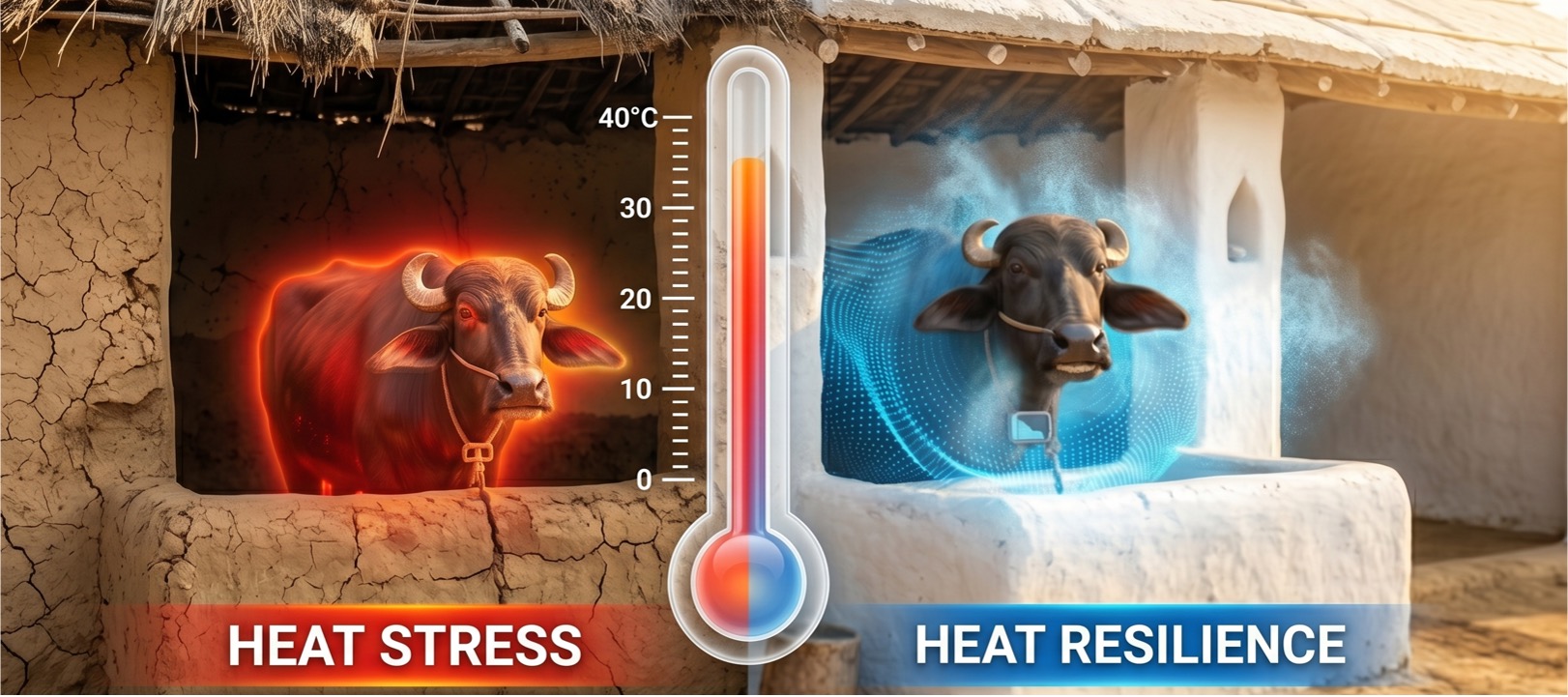
The most striking contrast of the study. NAF-fed animals lost just 50ml per session on average. The control group lost 340ml — a 15% collapse typical of sector-wide summer patterns. NAF acted as a heat resilience buffer.
Control Group Earnings Collapsed
Despite a marginal SNF increase, the control group saw net income fall from ₹70 to ₹52 per session as volume losses overwhelmed quality gains. SNF improvements mean nothing without yield resilience.
Smarter Feed = Lower Costs + Higher Net
Once NAF was introduced, many farmers voluntarily reduced expensive concentrates and khal. Even though NAF cost more per unit than green fodder, overall feed costs fell. Net income rose 8% — ₹96 to ₹104 — driven by both lower costs and higher revenue.
Estimated annual gain: ₹6,000–₹10,000 per animal
The Income Gap Over Time
As the study period progressed, the divergence between test and control group incomes widened significantly. Test group farmers averaged ₹104 per session post-NAF — while control farmers slid to ₹52. The projected annual net income gap between NAF-fed and traditionally-fed animals is estimated at ₹18,000–₹20,000 per animal — a transformational differential for smallholder dairy households.
Sub-cohort analysis also revealed that older animals (≈8 years, 3–4 calvings) showed the most significant fat and income gains from NAF, suggesting nutritionally-stressed animals benefit the most.
NAF-fed animals not only held their ground in peak summer — but pushed fat content higher, while control group performance stayed flat.
NAF helped farmers sidestep the summer slide — delivering steady milk volumes when most others saw sharp declines in yield.
With NAF, farmers didn't just earn more — they spent less to do it, turning a nutritional upgrade into a profitability engine.
Conducted at peak heat stress
The study ran through May 2025 in Ghatampur Block — with average daily highs exceeding 38°C, temperatures that regularly impair rumen function and suppress milk yield across the industry.
Two groups. Two very different outcomes.
Per-session performance comparison between the NAF-fed test group and the traditionally-fed control group across key income metrics.
Nutrition upgrade → income upgrade
Volume collapse eroded all quality gains
What Doodh Darpan reveals
NAF is a heat resilience tool
In conditions that typically devastate milk yield, NAF-fed animals maintained output — demonstrating that nutrition quality is a primary lever for climate adaptation in smallholder dairy.
Feed substitution drives profitability
NAF allowed farmers to reduce expensive concentrates and khal, lowering total feed costs while improving output quality. The net income gain was driven by both sides of the equation.
Older animals benefit most
Sub-cohort analysis showed the greatest gains in older buffalos (≈8 years, 3–4 calvings) — animals that are nutritionally stressed and respond poorly to suboptimal feeding.
Broader studies needed
Doodh Darpan is a strong foundation for a scaled, multi-state, multi-season research programme. The directional insights are compelling and warrant rigorous validation at larger sample sizes.
Study Limitations
Sample size: 650+ individual records over 23 days is robust for a single-district trial, but larger multi-state studies are needed for statistical power and broader applicability.
Geographic scope: Conducted in a single agro-climatic zone in Uttar Pradesh. Future research must include diverse geographies and climatic conditions to capture regional variability.
Hand milking variability: Addressed through within-farm paired design and digitally calibrated analyzers — but manual milking introduces inherent measurement variability.
Single season: This iteration is specific to peak summer heat stress conditions. Seasonal comparisons across monsoon and winter cycles are planned for future iterations.