
The Fresh Grid — How Shunya Scales Hyper-Local
From a 500-million-livestock crisis to a daily doorstep service. Here is the story of why India's fodder problem demands a fundamentally different model — and how Shunya built it.
India Has the World's Largest Livestock Population. It Cannot Feed Them.
India is home to over 500 million livestock — nearly 15% of the entire world's animal population — on just 2.3% of the world's land area. The country is the world's largest milk producer. And yet, the animals that drive this economy are chronically, structurally underfed.
The crisis is not one of demand — India's dairy economy is booming. The crisis is a supply-side structural failure. Green fodder, the single most nutritious feed component for dairy cattle, is in severe shortage across the country.
According to data presented to the Indian Parliament by the Union Minister for Fisheries, Animal Husbandry and Dairying, India currently faces a green fodder deficit of 11.24% to as high as 35.6% depending on the region and season — as documented by ICAR-IGFRI and confirmed in parliamentary proceedings. For key livestock states like Uttar Pradesh, Jharkhand, Uttarakhand and Odisha, the shortage is far steeper.
This shortage is directly responsible for Indian livestock producing milk at 20–60% below global average productivity, and for feed costs consuming 60–70% of total milk production expenses.
Union Minister Rajiv Ranjan Singh informed the Rajya Sabha (July 2024) that India faces a green fodder deficit of 11.24–35.6%, based on ICAR-Indian Grassland and Fodder Research Institute estimates. A 2023 peer-reviewed study puts green fodder deficit at 35.6% nationally.
Green fodder is not in deficit because farmers don't want to grow it. It is structurally constrained by resources that are both scarce and under increasing pressure.
Land Scarcity
Fodder crops compete directly with food crops for agricultural land. With food security priorities and shrinking farm sizes, there is simply not enough cultivable land available to grow fodder at scale.
Water Scarcity
Traditional green fodder cultivation is irrigation-intensive. In most livestock-dense states, groundwater depletion and erratic monsoons make year-round fodder farming economically and physically unviable.
Seasonal Variability
Monsoon dependency creates extreme feast-and-famine cycles in green fodder availability. Lean seasons mean cattle receive zero fresh nutrition for months, compounding long-term productivity losses.
Logistics & Freshness
Even where green fodder is available, its 80% moisture content makes long-distance distribution economically unviable — a transport tax on water that destroys unit economics and nutritional value alike.
Shunya Grows Green Fodder Where Land & Water Are Not the Constraint
Instead of fighting a structural land-and-water problem with more land and water, Shunya sidesteps it entirely — using hydroponics and vertical farming to produce Nutri Ankurit Feed (NAF), a sprouted grain green fodder of superior nutrition, using just 1% of the land and water that traditional cultivation would require.
Nutri Ankurit Feed — Fresh Fodder, Grown Indoors, Delivered Daily
Nutri Ankurit Feed is sprouted grain fodder (maize, wheat, barley) grown in climate-controlled, vertical hydroponic chambers at Shunya's Growth & Logistics Centres (GLCs). It is harvested fresh every single day and delivered to dairy farmers within 2–3 hours of cutting.
Because it is grown in a controlled system — not dependent on soil, rain, or season — Shunya can produce the same volume of high-nutrition green fodder every day, 365 days a year, in any geography, on a fraction of the space a traditional farm would need.
The Power of 1%
Hydroponics lets Shunya produce the same nutritional output as a conventional fodder farm — using orders of magnitude less land and water. This is not incremental efficiency. It is a categorical shift that makes GLCs deployable anywhere in rural India, regardless of agri-land availability.
Why This Must Be a Daily Subscription Service
NAF is not a product that can be stored, stockpiled, or sold in bulk. It is a living food — and that is precisely what makes it so nutritionally powerful. Freshness is not a feature. It is the entire model.
Enzymes Degrade Fast
Sprouted fodder reaches peak enzymatic activity at harvest. Within hours, heat and oxidation begin breaking down the very compounds that drive milk yield improvement. Delivery within 2–3 hours preserves this peak nutrition window.
2–3 hr delivery windowDaily Dose, Daily Impact
Cattle physiology is not optimised for weekly or ad-hoc supplementation. Consistent daily intake of fresh green fodder is what drives compounding improvements in milk production, reproductive health, and animal longevity.
Subscription modelFreshness Forces Hyper-Locality
A 2–3 hour harvest-to-trough window means Shunya's GLCs can only service a radius of ~10–12 km. This physical constraint defines the entire operational model — and is the design principle behind the MSM.
10–12 km service radiusThe Micro-Service-Market (MSM): Shunya's Atomic Unit of Operations
The 10–12 km delivery constraint is not a limitation — it is the design. Each Shunya GLC anchors a precisely defined Micro-Service-Market: a hub-and-spoke operational unit engineered to be both agriculturally viable and commercially self-sustaining.
Within a 10–12 km radius — roughly 300 sq. km — a single GLC hub can reach 25–30 villages, serving approximately 8,000 households with around 20,000 cattle heads. At a daily nutritional spend of ₹150 per cattle head, each MSM sits atop a ₹100–120 Crore annual market.
This is why the MSM is a win-win. The dairy farmer gets fresh, affordable, daily-delivered nutrition with no logistics burden. Shunya gets a dense, hyper-local, subscription revenue base with low last-mile delivery cost and minimal spoilage risk. Local village partners earn a livelihood. The model is profitable precisely because it is hyper-local.
Each MSM is not just a delivery zone — it is a self-contained economic unit with its own GLC production capacity, its own village partner network as spokes, and its own customer base of enrolled dairy farmers. The unit is optimised for both operational feasibility and commercial viability before Shunya expands to the next MSM.
The 10–12 km radius isn't arbitrary — it's determined by the 2–3 hour freshness window of NAF, rural road travel times, and the minimum density of cattle needed for GLC economics. Every constraint aligns: biology, logistics, and economics converge on the same unit.
Why the MSM is a Win-Win Model
The Shunya MSM is designed so every stakeholder benefits — not as a compromise, but as a structural inevitability of the model's design.
Premium Nutrition, Zero Hassle, Every Day
- Receives freshly harvested NAF at doorstep every morning — no sourcing, no storage
- Consistent green fodder year-round eliminates seasonal malnutrition in cattle
- Higher milk yield and better animal health improve household income directly
- Subscription model creates predictable cost — no price shocks or middlemen
- Village partner creates a local employment and trust relationship
Hyper-Dense Revenue, Profitable Unit Economics
- Dense subscription base within 10–12 km enables low last-mile delivery cost per kg
- GLC production scales predictably against enrolled subscriber count
- Zero long-haul logistics eliminates the transport tax that plagues centralised models
- Village partners as spokes reduce Shunya's direct distribution overhead
- Each MSM reaches profitability independently before the next is activated
The Fresh Grid: Engineering Maximum Coverage Through Densification
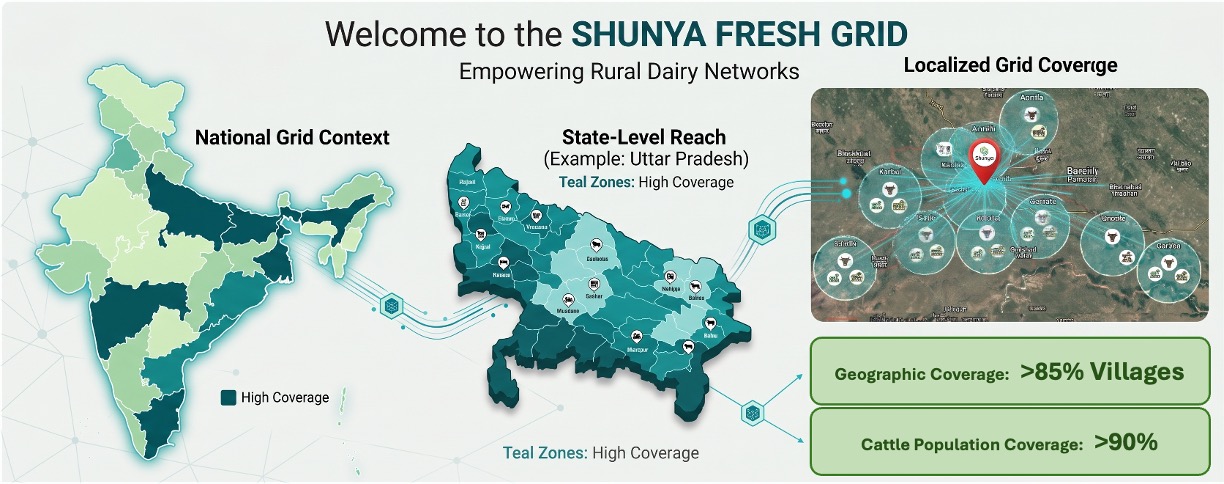
One MSM is a viable business unit. Fifty interlocking MSMs in a district are an infrastructure. The Fresh Grid is Shunya's analytical framework for engineering where to place GLCs so that their 10–12 km service circles interlock to cover the maximum number of villages and cattle heads — with minimal overlap and no coverage gaps.
The central question the Fresh Grid answers is deceptively simple: where do you put each GLC so that its MSM dovetails with the next? Get this right, and a district of hundreds of villages becomes 90%+ covered by a tightly-packed network of interlocking MSMs, each independently profitable, each supporting the others.
Densification — not sprawl — is the principle. Rather than spreading GLCs thin across a state to claim geographic presence, the Fresh Grid builds concentrated, fully-saturated clusters within priority districts. This ensures each GLC reaches profitability faster, delivery routes are shorter, and the network develops mutual resilience: a neighbouring GLC can absorb demand if one faces a temporary disruption.
The output of Fresh Grid analysis is a placement map: a precise spatial plan showing where each GLC hub should be located in a district, calibrated to actual road-network travel distances, village locations, and livestock census data — not just straight-line geometry.
District Prioritisation First
Not all districts are equal. Fresh Grid analysis begins by ranking districts by livestock density, severity of green fodder deficit, and land & water constraints. High-deficit, high-density districts get GLC clusters first — maximising impact per rupee deployed.
Densification Over Sprawl
The Fresh Grid does not try to claim a state by placing one GLC in every district. It builds dense, saturated clusters in priority districts — ensuring every GLC reaches subscriber density and profitability quickly before expanding to the next.
Road-Network Geometry
GLC placement is calculated on actual road-network travel times, not straight-line distance. In rural India, a 10 km straight-line radius may require 18 km of road travel. The Fresh Grid uses real routing data to ensure the 2–3 hour delivery window is always achievable.
Profitable at One MSM. Unstoppable at 5,000.
The Fresh Grid is designed so that the same district-level playbook — prioritise, densify, saturate — can be replicated state by state. Shunya targets 5 key livestock states with ~5,000 MSMs, representing a ₹3 Lakh Crore serviceable market.
The beauty of the Fresh Grid model is that scale does not require sacrificing local precision. Each new GLC is placed using the same spatial analysis, serving the same 10–12 km MSM. The unit economics do not dilute as the network grows — they strengthen, as procurement, brand, and operational expertise compound across GLCs.
Geographic coverage above 85% of villages and cattle population coverage above 90% within a district are the Fresh Grid's deployment targets. These are not aspirational — they are engineered outputs of the GLC placement methodology applied district by district.
Map Priority Districts
Rank districts in focus states by livestock density, green fodder deficit severity, and water/land constraints. Select highest-impact entry points.
Run Fresh Grid Analysis
Apply road-network geometry to engineer optimal GLC placement within the priority district — minimise gaps, minimise overlap, maximise coverage.
Deploy GLC Cluster
Establish the full hub-and-spoke cluster simultaneously rather than one-by-one — interlocking MSMs activate together, covering the district in one move.
Saturate the MSMs
Enrol dairy farmers as daily subscribers. Build village partner networks as spokes. Reach target subscription density and MSM profitability.
Replicate to Next District
Apply the proven playbook to the next priority district. Each deployment generates operational data that refines the next. The grid compounds.
Shunya is Building India's Green Fodder Infrastructure
From a single GLC to a national Fresh Grid — one interlocked MSM at a time. Join us as a Production Partner, village entrepreneur, or investor.