
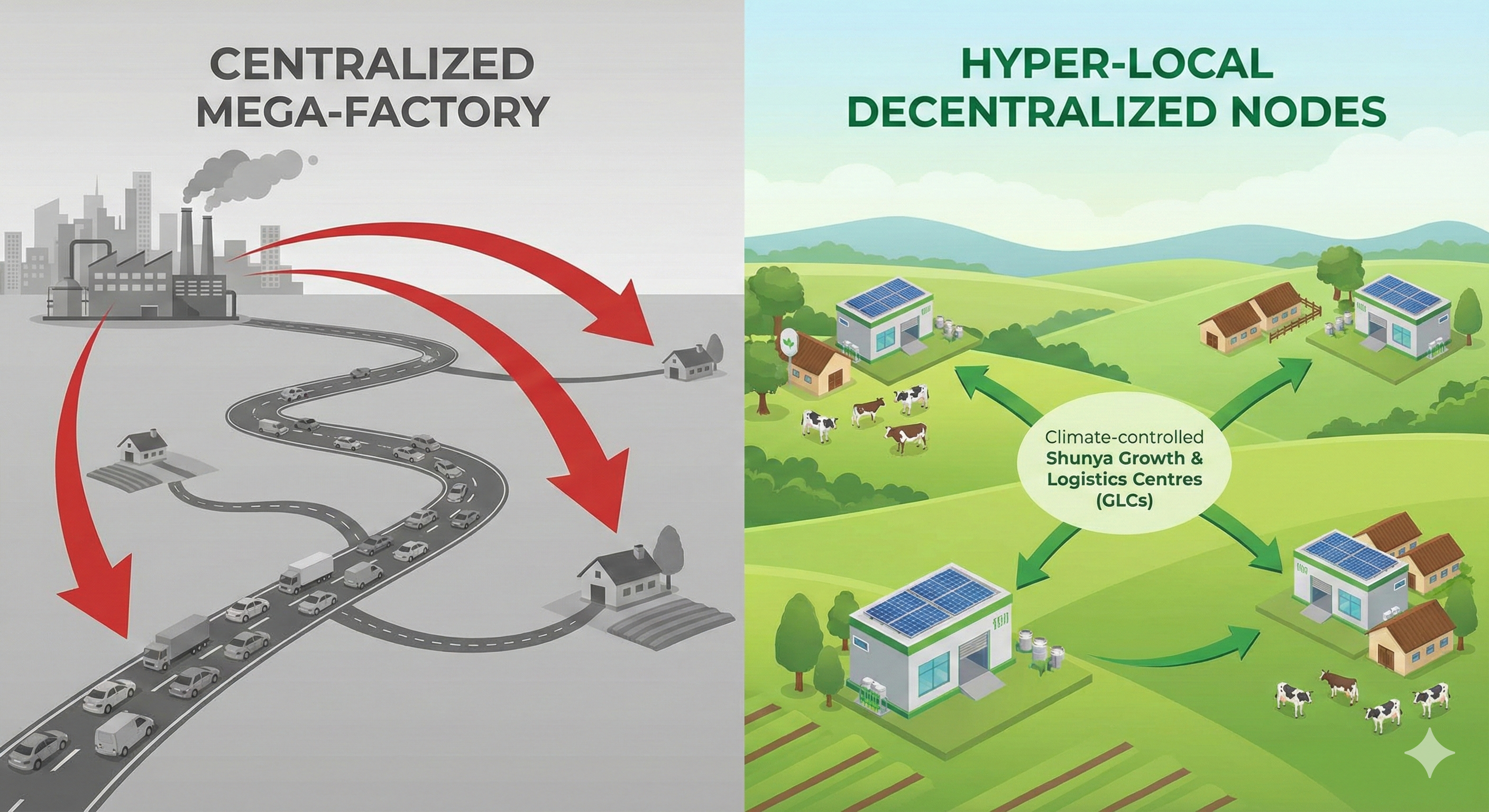
For the past century, the global approach to solving large-scale problems has been borrowed from the Industrial Revolution: Centralize and scale up. Hyper-Local was counterproductive.
If you need more cars, you build a massive mega-factory in one state and ship the vehicles globally. When this mindset was applied to agriculture, it created the massive centralized feed mills and mega-dairies we see today.
But agriculture is not manufacturing. It is biology!
When you centralize the production of highly perishable, biological goods (like fresh green fodder), you introduce massive systemic risks. You increase carbon emissions, create fragile supply chains, and, most importantly, you extract wealth from rural communities rather than building it.
At Shunya Agritech, we are challenging the “bigger is better” narrative. We believe the future of Indian agriculture is not a few massive mega-farms, but thousands of hyper-local, decentralized production hubs. Here is why the hyper-local model is the only sustainable path forward.
The Fragility of Centralization & the need for Hyper-Local
To understand the solution, we must look at why the centralized model fails in the context of fresh livestock nutrition:
- The Transport Tax: Fresh hydroponic fodder is incredibly nutrient-dense, but it is also heavy (retaining about 80% moisture). Shipping this from a centralized factory hundreds of kilometers away means you are primarily paying to transport water. This destroys the unit economics for the farmer.
- Single Point of Failure: If a centralized feed mill faces a power outage, a labor strike, or a localized natural disaster, thousands of farmers across multiple states lose their feed supply overnight.
- Nutritional Degradation: Every hour a fresh, living product sits in a truck, its enzymatic activity drops, and its nutritional value degrades.
The Hyper-Local Solution: Shunya’s Decentralized Nodes
Instead of building one facility that produces 100 tons of fodder a day, Shunya builds multiple Growth & Logistics Centres (GLCs) that produce 1 to 5 tons a day, placed exactly where the demand is.
We call this Hyper-Local Production.
By decentralizing our vertical farms, we place the production facility directly adjacent to the consumption zone. A Shunya GLC is designed to serve a tight radius, ensuring that the fodder grown in a specific district stays in that district.
This model mirrors the architecture of the internet: a distributed network of independent but connected nodes. If one node experiences an issue, the rest of the grid remains entirely unaffected.
Climate Resilience Through Distribution
Climate change is making Indian weather patterns increasingly unpredictable. We are seeing severe droughts in Maharashtra followed by unseasonal floods, while regions in Haryana experience extreme heatwaves.
Traditional agriculture is highly vulnerable to these regional shocks. A massive drought in a major fodder-producing state causes nationwide price spikes.
Decentralized, climate-controlled hydroponics isolates the food supply from these macro-weather events. Because our GLCs grow fodder indoors using 90% less water, a local drought does not mean a local famine for livestock. By distributing these climate-resilient hubs across the country, we create a national buffer against agricultural volatility.
Empowering the Micro-Entrepreneur
Perhaps the most profound impact of decentralized production is socio-economic.
Centralized mega-factories concentrate wealth. They take raw materials from rural areas, process them in industrial zones, and sell them back.
A hyper-local model keeps the economic engine within the village. This is the philosophy behind community integration initiatives. When a Shunya GLC is established, it doesn’t just provide fodder; it provides a platform for local entrepreneurship.
Because our technology is modular and standardized, it allows us to partner with local youth, empowering them to operate distribution nodes or even manage micro-production facilities. Instead of migrating to urban centers in search of jobs, rural entrepreneurs can build profitable, technology-driven agritech businesses in their own backyards. They become the crucial link between advanced hydroponic technology and the traditional dairy farmer.
The Sustainability Mandate: Eliminating “Food Miles”
In the global push for net-zero emissions, we must talk about “Food Miles”—the distance food travels from production to consumption.
The carbon footprint of trucking agricultural commodities across India is staggering. By producing fodder exactly where it is consumed, the Shunya model functionally eliminates long-haul logistics from the equation. Our delivery vehicles operate on short, localized loops.
This dramatic reduction in diesel consumption isn’t just an environmental victory; it is a core reason why our high-tech fodder remains economically viable for the smallholder dairy farmer. We took the money that would have been spent on fuel and invested it in superior nutrition.
In Conclusion: It is better to be Small, Smart & Connected! Be Hyper-Local
The future of Indian agriculture does not look like a sprawling, monolithic factory. It looks like a highly efficient, data-driven, climate-controlled unit operating quietly on the outskirts of a village, run by local entrepreneurs, feeding local cattle.
By moving away from the fragile, centralized models of the past, we are building a supply chain that is resilient, equitable, and infinitely scalable.
At Shunya, we aren’t trying to build the biggest farm in the world. We are building thousands of the smartest ones.
About Shunya Agritech
Shunya Agritech is a leading Fodder-as-a-Service provider building the future of dairy through innovation in hydroponic fodder in India. We grow and deliver affordable hydroponic fodder for small farmers, ensuring a year-round green fodder supply in India—regardless of season or geography. Our proprietary Nutri Ankurit Feed (NAF), grown using vertical farming for fodder, reaches farmers daily through a robust green fodder delivery network. Shunya’s hydroponic fodder delivery in India helps solve deep-rooted issues of nutrition, cost, and availability. Through our digital veterinary services in rural India, we also provide remote veterinary consultations for livestock, connecting farmers to expert care at the tap of a button. With our expanding network of Growth and Logistics Centres (GLC) and franchise-ready models, Shunya empowers communities, enhances milk productivity, and drives sustainable growth—one farm at a time.
Follow Shunya Agritech on Linkedin, X, Facebook & Instagram for regular updates. Subscribe to our Youtube Channel.