
FodderShield: Building Biological Resilience into Hydroponic Fodder Systems
The same controlled conditions that make hydroponic fodder grow fast also make it contaminate fast. FodderShield is Shunya Agritech’s multi-layered biosecurity protocol — built not as an add-on, but as the foundation that makes reliable output possible.
Editorial
May 2026
~8 min read
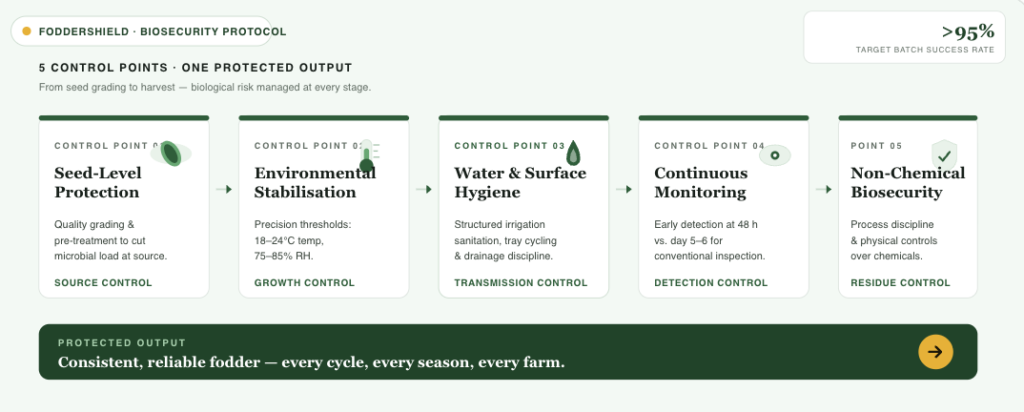
Five interdependent control points — each targeting a specific vulnerability across the hydroponic fodder growth cycle.
Hydroponic fodder has quietly moved from experiment to serious production infrastructure. The question is no longer can it grow? — the question is can it grow consistently, every day, without failure?
The Biological Threat Landscape in Hydroponic Fodder Production
Hydroponic fodder systems operate in warm, humid environments with constant moisture — precisely the conditions fungi and microbes thrive in. The problem is structural, not accidental. Seeds carry natural microbial loads. When soaked and germinated, these microbes encounter ideal conditions to multiply. If not controlled, they lead to mold formation, mycotoxin development, and compromised fodder quality.
Beyond fungi, hydroponic systems face a broader biological threat landscape. In recirculating systems, once a pathogen such as Pythium or Fusarium enters the water supply, it does not remain localised. Within hours, it can be distributed across an entire production unit — before any visual symptoms appear.
Key Biological Threats
| Threat Category | Primary Organisms | Entry Vector | Potential Impact |
|---|---|---|---|
| Seed-borne Fungi | Aspergillus, Fusarium, Alternaria | Contaminated seeds | Mold on sprouts, mycotoxin production, crop loss |
| Water-borne Oomycetes | Pythium, Phytophthora | Irrigation / nutrient solution | Root rot, rapid die-off across trays |
| Water-borne Bacteria | Pseudomonas, Erwinia | Recirculating water systems | Tissue necrosis, slime formation, off-odours |
| Airborne Spores | Botrytis, Cladosporium | Air currents, poor ventilation | Grey mold, cross-tray spread |
| Algae | Green & blue-green algae | Light + moisture on surfaces | Nutrient competition, altered water chemistry |
Source: International Journal of Plant and Soil Science; NAAS Advisory on Hydroponic Fodder Production.
The Mycotoxin Risk: A Hidden Danger in Contaminated Fodder
Of all the biological risks in hydroponic fodder production, mycotoxin contamination carries the most serious downstream consequences for livestock. Mycotoxins are secondary metabolites produced by mold fungi — particularly Aspergillus and Fusarium species — and they persist in fodder even after the visible mold is removed or the producing organism has died.
“
Studies estimate mycotoxin-contaminated feed causes a 10–30% reduction in dairy cattle milk yield — not including the cost of veterinary interventions and disrupted reproductive cycles.
| Mycotoxin | Producing Organism | Livestock Impact | Conditions Favouring Production |
|---|---|---|---|
| Aflatoxin B1 | Aspergillus flavus, A. parasiticus | Liver damage, reduced milk yield, immunosuppression | >25°C, >85% RH |
| Deoxynivalenol (DON) | Fusarium graminearum | Feed refusal, reduced weight gain | Cool, moist; wet seed lots |
| Zearalenone | Fusarium spp. | Reproductive disorders, estrogenic effects | Fluctuating temperatures, high moisture |
| Ochratoxin A | Aspergillus ochraceus, Penicillium spp. | Kidney damage, weight loss in poultry | Cool storage, high water activity |
Source: FAO Animal Feed Safety Guidelines; ScienceDirect.
Why Conventional Approaches Fall Short
The standard advice — use clean seeds, maintain optimal conditions, clean trays regularly, apply chemical disinfectants when contamination appears — is reactive rather than preventive. By the time a grower spots a contaminated tray, the pathogen has typically been present for 24–72 hours, already distributed through one or more irrigation cycles. In a 7–8 day production system, that is rarely recoverable.
Conventional Approach
- Inspect trays when mold is visible
- Respond with chemical disinfectants
- Approximate temperature and humidity
- Periodic tray cleaning between batches
- Outcome: 60–90% batch success
FodderShield Protocol
- Continuous monitoring; early-stage detection
- Process & physical controls, not chemicals
- Precision thresholds enforced all cycle
- Structured sanitation at every stage
- Outcome: >95% batch success (target)
Chemical disinfectants introduce their own risks when fodder is consumed directly by livestock: residues affecting animal health, resistance development in fungal strains, phytotoxicity if overdosed, and increasing regulatory scrutiny on residue thresholds. A dependence on chemicals masks root-cause vulnerabilities rather than addressing them.
Enter FodderShield: A Protocol, Not a Product
FodderShield is Shunya Agritech’s response to the structural limitations of conventional contamination management. It is not a single product, a chemical formulation, or a one-time treatment. It is a multi-layered biosecurity protocol designed to protect the entire growth cycle — from seed selection to harvest — by embedding contamination control into the system architecture itself.
“
Contamination control in hydroponics is about consistency, not correction. FodderShield is built on that principle.
The Five Control Points of FodderShield
Seed-Level Protection: Addressing Contamination at Its Source
The contamination cycle in many hydroponic systems begins before the first drop of water hits the seed. Seeds from commodity markets carry variable microbial loads — Fusarium, Aspergillus, and other seed-borne pathogens are common contaminants in commercially available maize, barley, and wheat lots. NAAS research identifies seed-borne contamination as the most significant entry vector for fungal pathogens in sprout-based systems.
- Quality grading to remove damaged or visibly contaminated seeds before soaking
- Pre-treatment protocols to reduce surface microbial loads without chemical residues
- Germination viability thresholds to prevent failed seeds from becoming mold substrates inside trays
Environmental Stabilisation: Precision Over Approximation
Temperature and humidity are the two most powerful levers in biological management. FodderShield enforces these parameters with precision rather than approximation — temperature and humidity thresholds are not targets to be broadly aimed at, they are boundaries that trigger intervention when breached.
- Optimal temperature: 18–24°C; risk zone above 28°C (accelerates fungal sporulation)
- Optimal relative humidity: 75–85% RH; condensation risk above 92% RH
- Air circulation monitored to eliminate dead zones where humidity pools
- Light exposure controlled to prevent algae formation on wet surfaces
Water and Surface Hygiene: Breaking the Transmission Chain
Water is the circulatory system of a hydroponic fodder unit. If not properly managed, it is also the primary transmission medium for pathogens. In recirculating systems, sanitation is not an event — it is a continuous state that must be actively maintained.
- Irrigation system sanitation: prevents biofilm formation (a reservoir for Pseudomonas and water-borne bacteria)
- Tray management: sanitised between cycles to eliminate residual spores without chemical carryover
- Water chemistry monitoring: pH and dissolved oxygen tracked; deviations favour specific pathogens
- Drainage discipline: standing water elimination removes the primary algae and bacterial slime substrate
Continuous Monitoring and Intervention: Early Detection Over Late Response
The single most impactful shift FodderShield introduces is moving from periodic inspection to continuous monitoring. A contaminated batch identified and isolated at 48 hours represents one or two trays lost. The same contamination, undetected until day 5 or 6, can represent an entire production cycle.
- Visual tray inspection protocols with documented criteria identifying early-stage markers before visible mold
- Environmental parameter logging to identify deviations before crop quality is affected
- Water quality checks — pH, turbidity, odour — at every irrigation cycle
- Batch segregation protocols: early-warning trays isolated before contamination spreads to adjacent racks
Non-Chemical Biosecurity: Process Discipline Over Chemical Dependency
FodderShield’s most distinctive pillar is its deliberate minimisation of chemical inputs. This is not ideology — it is a practical response to the realities of producing feed that is consumed directly by livestock. When fodder is the end product, chemical residues have direct downstream consequences for animal health, milk quality, and regulatory compliance.
- Process discipline as the primary contamination barrier, not chemistry
- Physical controls: UV sterilisation, controlled airflow, surfaces selected for biofilm resistance
- Biological management: conditions that favour healthy plant development over pathogen proliferation
- Where chemical intervention is necessary, low-residue agents applied with precision, not as blanket treatments
A Made-in-India Solution for Real-World Conditions
Hydroponic fodder systems in India operate under conditions far more challenging than those assumed in international research: summer temperatures of 40–45°C, intermittent power supply interrupting environmental controls, the dramatic humidity swings of the Indian monsoon (pre-monsoon aridity to 90%+ RH in peak monsoon), and variable commodity seed quality.
FodderShield has been designed with these realities in mind. The protocol is robust, adaptable, and suited for decentralised production environments like Shunya’s Green Livelihood Centre (GLC) network — units operated by farmers and rural entrepreneurs, often without specialist technical support on-site. Its emphasis on process discipline over high-tech monitoring infrastructure means it is deployable at the farm level by any trained operator.
The Economics of Reliability
For a dairy farmer depending on a hydroponic fodder unit, batch failures are not merely inconvenient. They represent immediate feed deficits covered at market rates, disruption to feeding schedules affecting milk yield consistency, animal health risk if contaminated fodder is fed, and ultimately lost confidence in the hydroponic system itself.
| Production Scenario | Batch Success Rate | Annual Failures (Est.) | System Trust Level |
|---|---|---|---|
| Unmanaged / Reactive | 60–75% | 15–25 batches/year | Low — heavy supplementation needed |
| Conventional Best Practice | 80–90% | 5–15 batches/year | Moderate — periodic disruptions accepted |
| FodderShield Protocol | >95% (target) | <5 batches/year | High — unit integrated into feeding plan |
Indicative comparison based on operational experience and research benchmarks for controlled-environment sprouting systems.
The shift from 80% to 95%+ batch success may appear incremental. In practice it is transformative: at 80% a farmer experiences a failure roughly once every five days — frequent enough that the unit cannot be relied upon as a primary feed source. At 95%+, failures become rare events rather than routine occurrences, and the unit becomes a stable, plannable component of the farm’s nutrition programme.
Before you evaluate a hydroponic fodder system, ask:
- Does the unit have a stated biosecurity protocol, or does it rely on periodic chemical treatment?
- What is the uptime guarantee across seasons — including monsoon and peak summer?
- Is operator SOP training and protocol transfer part of the package?
- Are seed sourcing standards specified, or left to the operator?
- What is the documented batch success rate across an operating year?
From Growth to Assurance
The future of hydroponic fodder will not be defined by yield potential alone. As adoption scales — across dairy, small ruminant, and poultry sectors — the defining question will shift from “Can it grow?” to “Can it grow consistently, every day, without failure?”
FodderShield answers that question by embedding biosecurity into the DNA of the production system. It converts hydroponic fodder from an opportunity into a dependable, scalable solution for livestock nutrition. And in a sector where consistency directly impacts farmer income, animal health, and food system resilience — that shift is not incremental. It is foundational.
Key Takeaways
- Hydroponic fodder systems face structural biological risk — contamination is not occasional, it is continuous.
- Mycotoxins cause 10–30% milk yield loss and persist even after visible mold is removed.
- Conventional reactive approaches leave 60–90% batch success — too variable for a primary feed source.
- FodderShield targets >95% batch success through five interdependent control points.
- The protocol is designed for Indian farm conditions — high heat, variable power, monsoon humidity, commodity seed quality.
- Reliability, not yield, is the metric that determines farmer income from hydroponic fodder.
FAQs: FodderShield and Hydroponic Fodder Biosecurity
What is FodderShield?
What are the biggest contamination risks in hydroponic fodder systems?
Why is a protocol better than just using chemical disinfectants?
Is FodderShield suitable for small-scale farm-level units?
How does FodderShield affect the economics of a hydroponic fodder unit?
Continue reading
biosecurity protocol
hydroponic fodder
mycotoxin risk
Shunya Agritech
livestock nutrition
fodder contamination
GLC network
ProductionOS