
To the naked eye, a dry maize or barley seed looks inert. It is hard, dry, and seemingly lifeless. If you were to feed this raw grain to a cow, as millions of farmers do every day, you would certainly provide them with calories. But you would also be missing out on the vast majority of the potential energy locked inside that shell.
Nature has designed seeds to be “survival capsules.” They are built to withstand harsh winters, droughts, and long periods of storage. To do this, the seed locks its nutrients away in complex, hard-to-digest forms (like starch and phytate) and surrounds them with anti-nutrients to discourage animals from eating them.
At Shunya, we don’t just feed cattle; we unlock nature. Through our hydroponic sprouting process, we trigger a biological explosion known as “Enzymatic Activation.” This process turns a dormant survival capsule into a living, breathing superfood.
But what exactly happens during those 7 crucial days inside our vertical farms? Let’s take a look under the microscope.
The Villain: Anti-Nutrients and Phytic Acid
Before we discuss the benefits of sprouting, we must understand the problem with raw grain.
Raw grains contain compounds called anti-nutrients, the most notorious of which is Phytic Acid. Think of Phytic Acid as a “mineral blocker.” When a cow eats raw grain, the Phytic Acid binds to essential minerals like calcium, magnesium, iron, and zinc in the cow’s digestive tract. It locks them up, preventing the animal from absorbing them.
This means that even if you are buying expensive, mineral-rich feed, your cattle might simply be excreting those minerals because of the anti-nutrients present in the raw grain. This is a massive, invisible loss for the Indian dairy farmer.
The Trigger: The First 24 Hours
The magic begins the moment the seed hits the controlled environment of a Shunya tray. The specific combination of moisture, temperature, and darkness signals to the seed that “winter is over.”
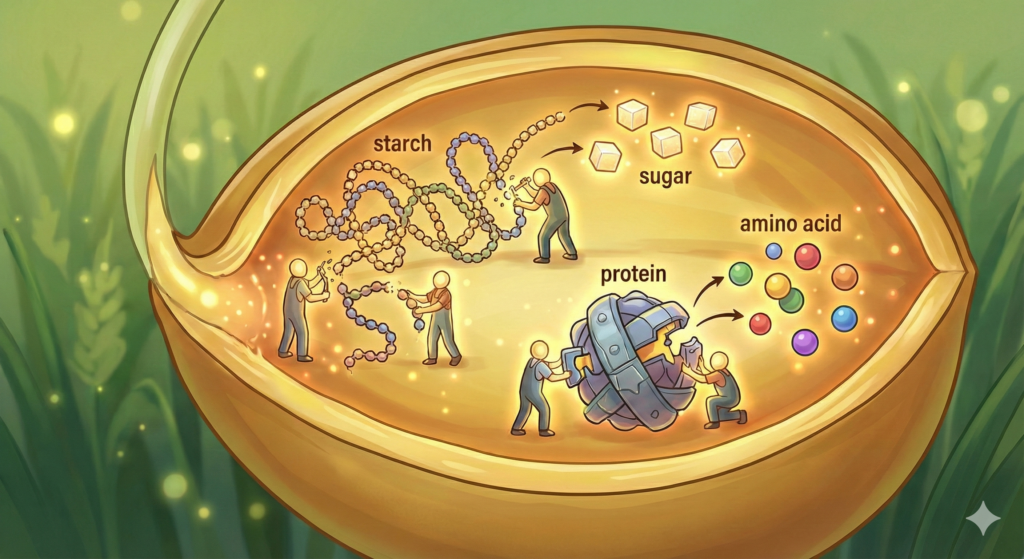
The seed absorbs water, swelling in size. This rehydration dissolves the inhibitors that kept the seed dormant. The hard outer shell softens, and the seed’s internal factory wakes up. It begins to produce Enzymes.
Enzymes are biological catalysts: tiny workers that speed up chemical reactions. In a dormant seed, they are asleep. In a “Nutri Ankurit” sprout, they are working in overdrive.
The Transformation: Starch to Sugar, Protein to Amino Acids
As the sprout grows over the 7-day cycle, two massive chemical shifts occur that change the feed from “maintenance diet” to “production diet.“
1. The Breakdown of Starch
Raw grain is primarily starch. Starch is a complex carbohydrate—a long, tangled chain of energy that requires a lot of effort for a cow’s rumen to break down. This is why heavy grain feeding can sometimes lead to acidosis (acidity) in cattle; the rumen struggles to process the heavy starch load.
During the sprouting process, an enzyme called Amylase is activated. Amylase attacks the complex starch and chops it up into simple sugars (glucose and sucrose).
Why does this matter? Simple sugars are “ready-to-use” energy. They are absorbed rapidly by the cow, providing an immediate boost to energy levels without stressing the digestive system. This is why cattle fed on Shunya fodder often display higher energy and shinier coats—they are running on premium fuel, not crude oil.
2. The Unlocking of Proteins
Raw grain contains protein, but it is often “complex” and hard to digest. During sprouting, an enzyme called Protease breaks these long protein chains down into free Amino Acids.
Amino acids are the building blocks of life. By breaking the protein down before the cow eats it, we are essentially “pre-digesting” the food. The cow doesn’t have to waste metabolic energy breaking down the feed; it can use that energy for milk production and immunity instead.
The Vitamin Explosion
Perhaps the most miraculous change is the synthesis of vitamins. A dry seed has very low levels of vitamins. It doesn’t need them yet. But a growing plant needs vitamins to survive.
Research into hydroponic fodder indicates that during the sprouting process:
- Vitamin A (Beta Carotene) content can increase dramatically. Vitamin A is crucial for reproductive health and fertility in cattle.
- Vitamin E levels rise, acting as an antioxidant that boosts the cow’s immune system.
- B-Complex Vitamins are synthesized, aiding in metabolism.
When a farmer feeds dry fodder or straw, they often have to supplement with expensive synthetic vitamins. With Nutri Ankurit fodder, these vitamins are delivered naturally, in a bio-available form that the body recognizes and absorbs instantly.
The Water Factor: Hydration from Within
In the Indian summer, heat stress is a silent killer of profits. Cows stop eating, milk yield drops, and dehydration sets in.
Dry feed requires the cow to drink huge amounts of water to process it. Nutri Ankurit fodder is a “living water bottle.” It is a high-moisture feed (approx 80-85% water). But this isn’t just plain water; it is cellular water, rich in electrolytes and nutrients.
When a cow eats a mat of Shunya fodder, she is simultaneously eating and drinking. This internal hydration helps regulate body temperature, keeping the animal cool even when the ambient temperature rises. A cooler cow is a more productive cow.
In conclusion: Trusting the Science
For decades, we have measured feed by weight. “I fed 5kg of grain,” a farmer might say. But weight is a crude metric. We should be measuring feed by absorption.
If you feed 5kg of grain but the cow only absorbs 60% of the nutrients due to Phytic Acid and complex starches, you have wasted money. If you feed Nutri Ankurit Feed, where the enzymatic activation has already done the hard work, the absorption rate is significantly higher.
At Shunya, we aren’t creating new nutrients; we are simply using science to unlock what nature has already provided. By controlling the environment; temperature, humidity, and light; we ensure that every tray of fodder reaches its peak enzymatic potential before it reaches your doorstep.
It is the difference between eating a bag of flour and eating a slice of bread. One is an ingredient; the other is food.
Your cattle know the difference. It’s time your bottom line did too!
About Shunya Agritech
Shunya Agritech is a leading Fodder-as-a-Service provider building the future of dairy through innovation in hydroponic fodder in India. We grow and deliver affordable hydroponic fodder for small farmers, ensuring a year-round green fodder supply in India—regardless of season or geography. Our proprietary Nutri Ankurit Feed (NAF), grown using vertical farming for fodder, reaches farmers daily through a robust green fodder delivery network. Shunya’s hydroponic fodder delivery in India helps solve deep-rooted issues of nutrition, cost, and availability. Through our digital veterinary services in rural India, we also provide remote veterinary consultations for livestock, connecting farmers to expert care at the tap of a button. With our expanding network of Growth and Logistics Centres (GLC) and franchise-ready models, Shunya empowers communities, enhances milk productivity, and drives sustainable growth—one farm at a time.
Follow Shunya Agritech on Linkedin, X, Facebook & Instagram for regular updates. Subscribe to our Youtube Channel.
Pingback: Hydroponics v/s Soil: Comparative Analysis of Mineral Uptake
Pingback: Beyond Cows: Why Goat Farmers are excited about Hydroponic Fodder