
The Evolution of Goat – The “Poor Man’s Cow”
For centuries, the goat has been affectionately (and somewhat dismissively) known as the “poor man’s cow” in India. Traditionally managed through open grazing by marginalized communities, goat farming was rarely viewed as a scalable, high-tech enterprise.
That narrative is rapidly changing.
Driven by rising demand for premium meat (chevon) and the recognized health benefits of goat milk, commercial goat farming is undergoing a massive transformation. The industry is shifting from unorganized, free-roaming herds to intensive, scientifically managed stall-fed operations. As the sector digitizes, with the rise of dedicated livestock exchanges and digital management platforms, entrepreneurs are demanding higher standards for every input.
The biggest input of all? Nutrition.
At Shunya Agritech, we are seeing a massive surge in demand from commercial goat farms. But why are modern goat farmers moving away from dry scrub and traditional feed to adopt our Nutri Ankurit hydroponic fodder? The answer lies in the unique biology of the goat.
Goat population in India is on the rise. Many commercial goat farms have come up in the past few years. Goat farming is increasingly been seen as an attractive investment avenue by entrpreneurs as well as small marginal owners, because of the multiple output avenues available (milk, meat, etc). However just like cattle, the goats also face the impact of the green fodder deficit. Goats, till today, are majorly grazing animals and as grazing lands disappear, the lack of supply of green fodder will start impacting the growing industry.
Hydroponics is probably the only sustainable solution that can help the industry grow at breakneck speed. However, the impact of hydroponically grown green fodder on goat productivity has not been as deeply studied as it has been for cattle. Hence, Shunya partnered with Central Institution for Research on Goats (CIRG) – a premier institution under ICAR, focused on research and propagation of goat farming – to jointly study and bring about a proactive fodder revolution.
But there are many facets to goats that make hydroponically grown fodder, a very attractive option because of which we are seeing the uptick in demand. Lets explore some of these.
The Biology of a Browser
To feed a goat efficiently, you must first understand how it eats.
Cows and sheep are grazers. Their natural instinct is to lower their heads and consume the grass in front of them in bulk.
Goats, on the other hand, are browsers. They are notoriously picky eaters. A goat’s natural instinct is to forage at head height or above, nibbling on leaves, shoots, and young bark. They have highly mobile upper lips that allow them to sort through feed, selecting only the most nutritious, palatable parts and discarding the rest.
When you put dry, rough fodder or coarse hay in front of a stall-fed goat, their browsing instinct kicks in. They will sift through it, eat the best bits, and trample the rest into the dirt. In a commercial farm, trampled feed is wasted money.
The Zero-Waste Paradigm with Goats
This is where Shunya’s hydroponic fodder fundamentally changes the economics of the stall-fed model.
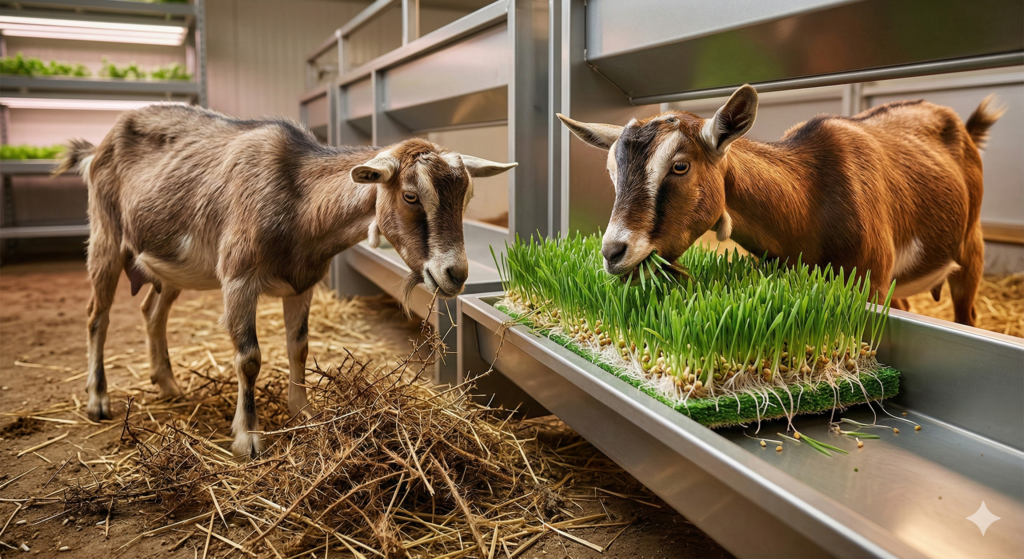
Our Nutri Ankurit fodder is delivered as an intact, living mat consisting of the green shoot, the enzymatically activated seed, and the clean white root system. Because the entire mat is highly palatable, tender, and uniform in its nutritional profile, the goat’s instinct to “sort and discard” is bypassed.
- Traditional Feed: Up to 30-40% wastage due to trampling and selective eating.
- Shunya Fodder: 100% edibility. They consume the shoot, the seed, and the roots. Zero waste.
When every gram of feed you purchase is actually consumed by the animal, your Return on Investment (ROI) immediately improves.
Accelerated Weight Gain and Meat Quality
For commercial meat farms, the ultimate metric is Days-to-Market. How quickly can a kid reach its optimal selling weight?
Feeding excessive dry grain to goats to accelerate weight gain is dangerous. It can lead to severe metabolic issues like urinary calculi (kidney stones) and acidosis.
Hydroponic fodder offers a safer, faster path to market weight. Because the sprouting process pre-digests complex starches into simple sugars and unlocks high-quality amino acids, the goat assimilates the protein rapidly without the metabolic stress associated with heavy grain diets.
Furthermore, the high moisture content and natural vitamins in the green fodder result in a visibly healthier animal. Farmers consistently report a shinier, thicker coat and better muscle-to-fat ratios in the meat—traits that command a premium price on modern livestock exchange platforms.
The Water Factor in Stall-Feeding
Stall-feeding restricts an animal’s natural movement, which can sometimes lead to decreased water intake, especially in arid regions like Rajasthan, Haryana, and parts of Maharashtra. Low water intake directly impacts digestion and growth.
Shunya’s hydroponic fodder consists of roughly 80-85% cellular water. When a goat eats our fodder, it is simultaneously hydrating itself. This “living water” is rich in dissolved minerals and enzymes, keeping the animal’s digestive tract functioning optimally and reducing the risk of heat stress during harsh Indian summers.
Immunity and Disease Resistance
In high-density commercial farms, disease outbreaks (like PPR or goat pox) can wipe out a year’s profit in days. While vaccinations are critical, a strong baseline immune system is the first line of defense.
Hydroponic sprouts are naturally rich in Vitamin A, Vitamin E, and readily absorbable trace minerals like Zinc and Copper. These micronutrients are essential for building a robust immune response. Healthier goats mean lower veterinary bills, lower mortality rates among kids, and a more predictable business model.
Conclusion: Fueling the Modern Goat Farm
The goat farming industry is no longer just a rural survival strategy; it is a serious, tech-enabled business. Today’s goat entrepreneurs are tracking genetics, utilizing digital marketplaces to connect with buyers, and managing their herds with precise data.
But all the digital tools and genetic tracking in the world cannot compensate for poor nutrition.
To run a modern, profitable stall-fed operation, you need modern, precision feed. Shunya’s Nutri Ankurit fodder provides the consistency, zero-waste efficiency, and bio-available nutrition required to scale a goat farm successfully.
It is time to stop feeding your premium livestock like it’s the 19th century. Welcome to the future of high-performance nutrition.
About Shunya Agritech
Shunya Agritech is a leading Fodder-as-a-Service provider building the future of dairy through innovation in hydroponic fodder in India. We grow and deliver affordable hydroponic fodder for small farmers, ensuring a year-round green fodder supply in India—regardless of season or geography. Our proprietary Nutri Ankurit Feed (NAF), grown using vertical farming for fodder, reaches farmers daily through a robust green fodder delivery network. Shunya’s hydroponic fodder delivery in India helps solve deep-rooted issues of nutrition, cost, and availability. Through our digital veterinary services in rural India, we also provide remote veterinary consultations for livestock, connecting farmers to expert care at the tap of a button. With our expanding network of Growth and Logistics Centres (GLC) and franchise-ready models, Shunya empowers communities, enhances milk productivity, and drives sustainable growth—one farm at a time.
Follow Shunya Agritech on Linkedin, X, Facebook & Instagram for regular updates. Subscribe to our Youtube Channel.
Pingback: Stall-Feeding Success: Optimizing Meat Quality in Small Ruminants - Shunya Fodder & Animal Nutrition