
Green LarvaEx: A Biological Answer to Larvae Damage in Hydroponic Fodder Units
A new powder from Shunya Labs stops larvae feeding within hours of exposure, protecting germinating grain without leaving chemical residue on fodder animals eat within days.
Hydroponic fodder units are warm, humid and enclosed, which is exactly what makes them good at growing fodder fast, and just as attractive to insect larvae. Infestation tends to arrive quietly, through a contaminated grain lot, an unscreened ventilation opening, or eggs laid inside the unit by adult insects before anyone notices. Once established, larvae feed on germinating grains, tender roots and young shoots, and the damage compounds quickly. Germination drops, yield falls, and the surviving fodder carries a higher risk of secondary contamination.
Globally, insect activity alone is estimated to destroy around 10 percent of stored food production every year, and the losses are not limited to volume. Infested grain also loses protein, lipids and feed quality as damage progresses. (Stathas et al., Foods, 2023)
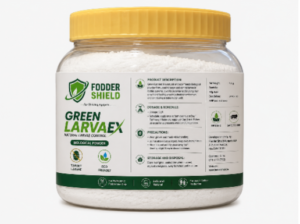
Turning the Larva’s Own Gut Against It
Green LarvaEx, the newest addition to Shunya Labs’ Fodder Shield range, takes a biological route to this problem rather than a chemical one. The powder is applied to the surface of germinating grains and sprouts, where it stays in place until a larva feeds. Along with the grain, the larva ingests naturally occurring bacterial spores and bioactive compounds carried in the formulation.
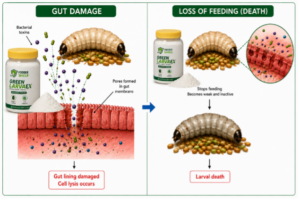
Inside the larval gut, these compounds activate and bind to the gut lining, opening pores in the membrane and damaging the tissue beneath it. The gut loses its integrity, digestion and nutrient absorption break down, and the larva stops feeding almost immediately. This closely mirrors the documented mode of action of Bacillus thuringiensis based biological insecticides, among the most extensively studied biological pest controls in agriculture: the toxins bind midgut receptors, form pores in the brush border membrane, and trigger feeding cessation as an early response, well before the insect eventually dies of dehydration and nutrient imbalance. (Pinos et al., Microbiology and Molecular Biology Reviews, 2021)
Bacillus thuringiensis based formulations are valued in pest management for their host specificity: their toxins require particular midgut receptors that are largely absent in mammals and most non-target organisms, and label-rate applications are broadly regarded as safe for beneficial insects, livestock and humans. Their Cry proteins also do not persist indefinitely once applied. One field study found bioactivity fell to under 25 percent of its initial level within 120 days, with most of the decline occurring in the first six weeks.
Belousova et al., Toxins, 2021
Protecting Yield Without Compromising What Animals Eat
Stopping larvae from feeding does more than save the tray in front of it. It protects germination, root development and early shoot growth, which is where most of a hydroponic batch’s eventual biomass is decided. It also lowers the odds of secondary microbial contamination, since insect-damaged tissue is more vulnerable to colonisation by opportunistic fungi and bacteria than healthy, intact plant material.
Because hydroponic fodder is harvested and fed within days rather than stored for weeks, how a formulation behaves after it has done its job matters as much as how it works. The bioactive compounds in Green LarvaEx act on the target larva and then break down under normal environmental conditions rather than accumulating in the fodder mat, consistent with the wider literature on Bacillus thuringiensis based formulations, which are valued for host-selective action and for not persisting indefinitely in the environment.
For an operator running a 200-tray unit, or one running several thousand, a larval outbreak has traditionally meant losing entire batches with no reliable in-season fix. A biological powder that needs no specialised equipment and folds into an existing Fodder Shield routine turns a recurring point of loss into a manageable, budgeted input, the kind of shift from scarcity to abundance that decentralised fodder production across the Global South depends on.
Green LarvaEx does not replace good sanitation and clean seed sourcing. Screening ventilation, sourcing clean grain lots and following a broader biosecurity protocol remain the first line of defence for any hydroponic fodder unit. What it adds is a targeted, biological backstop for the larvae that get through anyway, without asking farmers to introduce a chemical residue into feed their animals will eat within the week.
- Pinos, D., Andrés-Garrido, A., Ferré, J., & Hernández-Martínez, P. Response Mechanisms of Invertebrates to Bacillus thuringiensis and Its Pesticidal Proteins. Microbiology and Molecular Biology Reviews, 85(1) (2021). DOI: 10.1128/mmbr.00007-20
- Belousova, M.E., Malovichko, Y.V., Shikov, A.E., Nizhnikov, A.A., & Antonets, K.S. Dissecting the Environmental Consequences of Bacillus thuringiensis Application for Natural Ecosystems. Toxins, 13(5), 355 (2021). DOI: 10.3390/toxins13050355
- Stathas, I.G., Sakellaridis, A.C., Papadelli, M., Kapolos, J., Papadimitriou, K., & Stathas, G.J. The Effects of Insect Infestation on Stored Agricultural Products and the Quality of Food. Foods, 12(10), 2046 (2023). DOI: 10.3390/foods12102046